Physics-Constrained CNN and Bayesian Inference for Beam-Parameter Inversion
Jul 2025 - Feb 2026 · Jie Xu’s group, School of Physics and Astronomy, SYSU · First author · University Physics accepted · National Second Prize, AI + Physics Experiment Track
Problem. Measuring a laser’s waist radius, waist position, and beam quality factor usually relies on a second-moment integral, which diverges on noisy, saturated, or uneven spots. A bare CNN reads the beam width, but it tells you nothing about how trustworthy the number is or whether it follows Gaussian propagation.
Insight. Pair the neural network with a physical equation as referee and a probability distribution for uncertainty, turning black-box fitting into a checkable measurement.
Method.
- Trained a CNN on 25,600 physics-driven synthetic spots with realistic detector noise, reaching 2.32% MAPE on beam width.
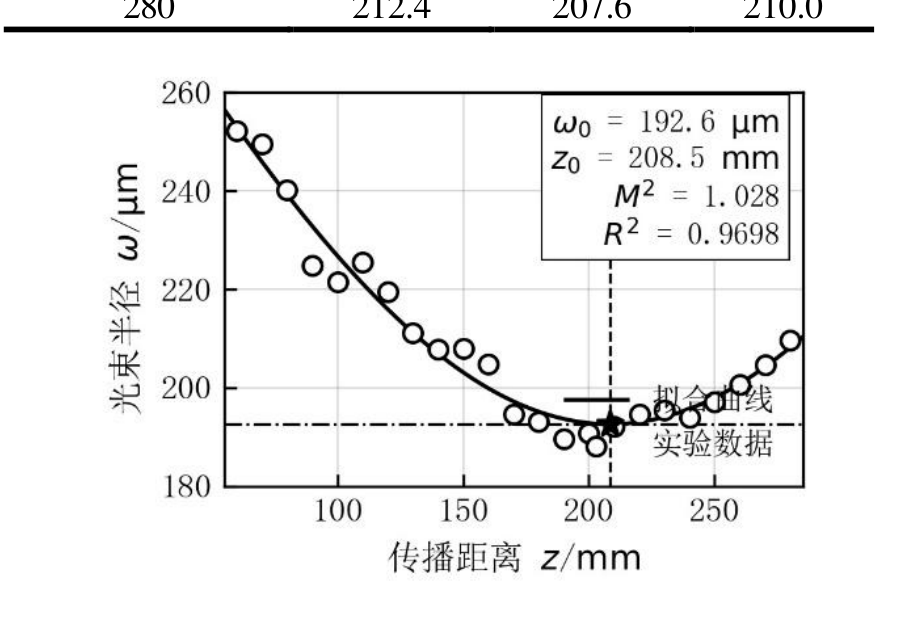
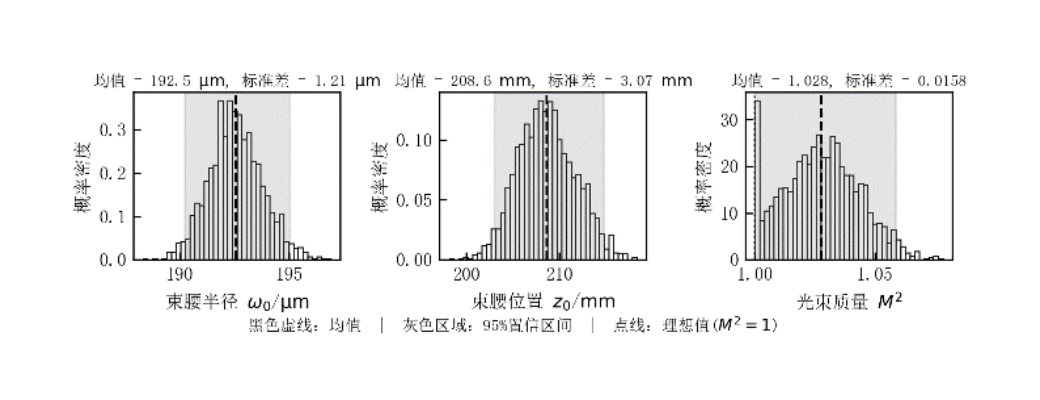
- Fed the CNN widths into the Gaussian-beam hyperbolic equation and fit with Levenberg-Marquardt; added MCMC posterior sampling and Monte Carlo perturbation for uncertainty analysis.
Result.
- Fit R² 0.987 on a single lens, 0.982 transferred to a lens group; beam quality factor 1.028 near the ideal mode.
- Monte Carlo uncertainty 1.21 µm, 24% lower than the conventional 1.60 µm, explained by a -0.76 correlation between waist position and quality factor.
- Accepted at University Physics; National Second Prize in the AI + Physics experiment track.
Takeaway. A number without a physical equation and a probability distribution floats in the air. Interpretability decides whether the number can be trusted.