S-Crescendo: Simulating Higher-Order Nonlinear Circuits
Dec 2024 - May 2025 · Guanzhong’s group, School of Microelectronics Science and Technology, SYSU · Third author · NeurIPS 2025 accepted
Problem. In chip backend design, nonlinear drivers sit next to complex RC parasitic networks. As circuit order climbs, SPICE’s Newton-Raphson iterations and matrix solves become prohibitively expensive. Existing surrogates speed up a single simulation but drop waveform detail in steep transients and fail on higher-order networks never seen in training.
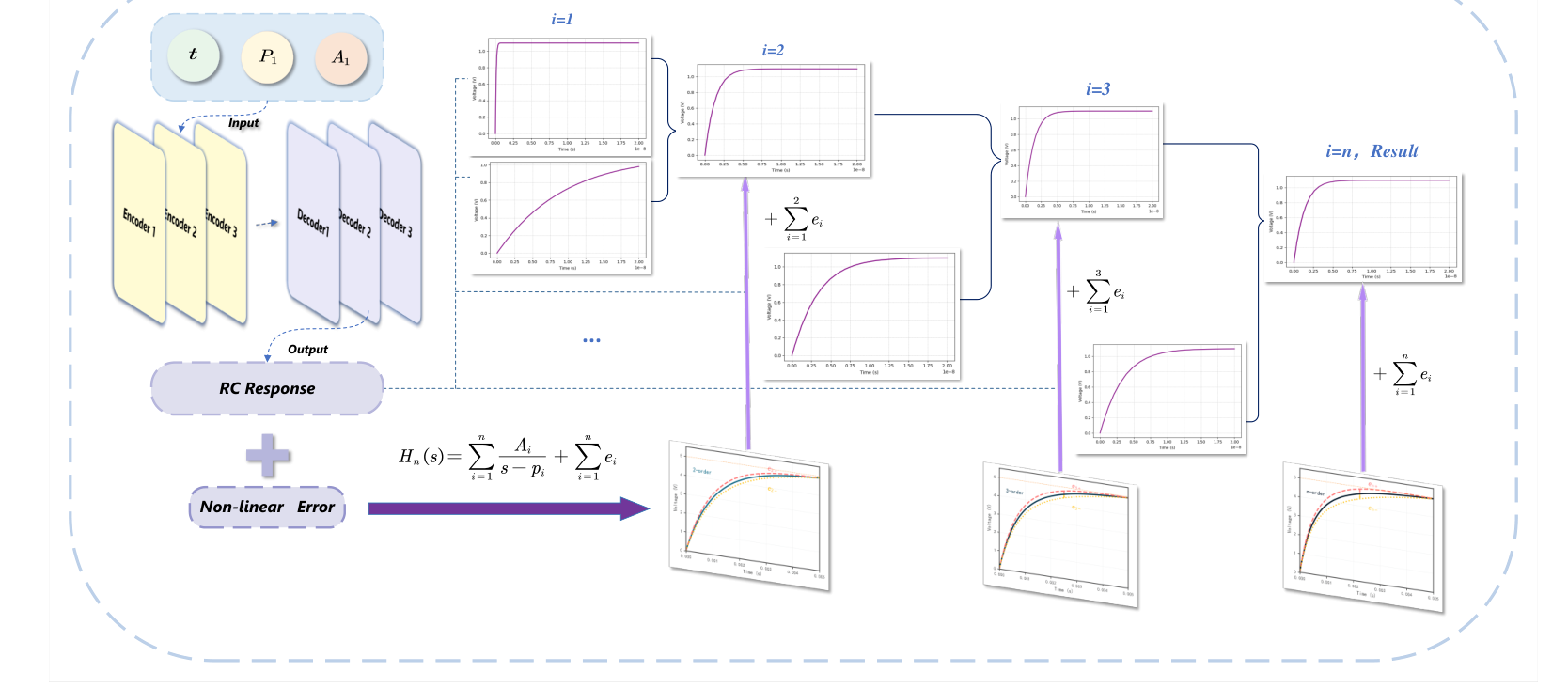
Insight. An RC network decomposes in the S-domain into poles and residues, each pair a decaying mode. If the model reads these modes instead of memorizing whole waveforms, rules learned on low-order systems can be carried step by step to higher orders.
Method.
- Built HSPICE training data from first- to third-order RC netlists: extracted nodes, resistors, and voltages, then fit transfer functions into pole-residue expansions.
- Proposed Markov-style state compression for higher-order generalization: keep only the previous and current order’s poles, residues, and time, so each correction answers one small question.
Result.
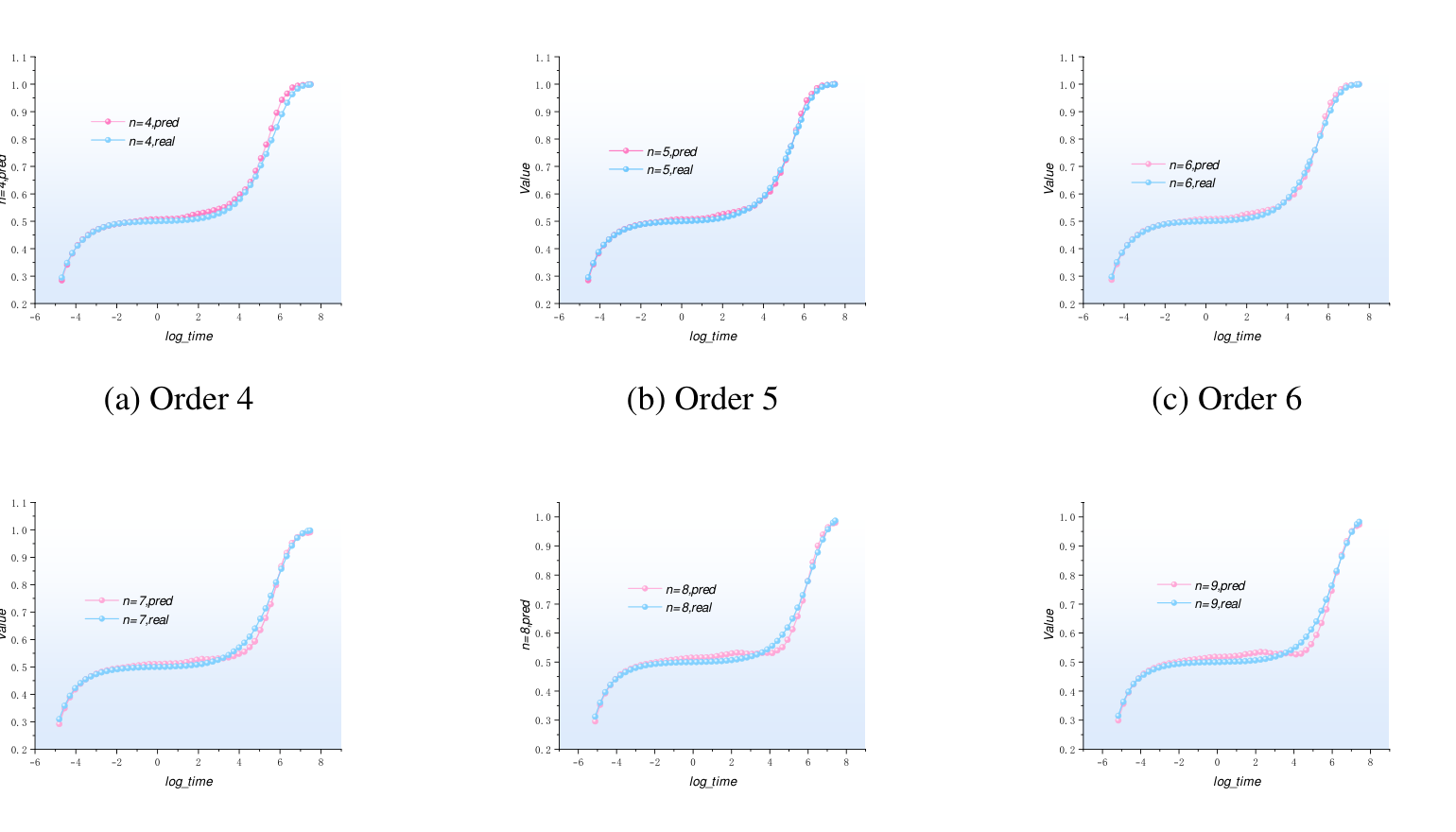
- Trained on circuits up to third order, tested directly on fourth through ninth: R² ≈ 0.984 on ninth-order nonlinear circuits.
- Up to 18.6× inference speedup over commercial HSPICE on 10 ns / 1000-step transients.
- Accepted at NeurIPS 2025.
Takeaway. Data preprocessing decides what the model can see. The form in which a physical object enters the network already writes down the rules it can learn, and the parts it cannot.